Quick Answer: CNC turn mill parts are produced on machines that combine turning and milling operations in a single setup, using live tooling and multiple axes to cut features that would otherwise require moving a part between separate lathes and mills. The result is fewer setups, tighter tolerances, and shorter lead times for geometrically complex components.
Picture a part that needs a turned cylindrical body, a flat milled face, a cross drilled hole, and a keyway, all on the same piece. Machined the traditional way, that part travels between a lathe and a mill at least twice, and every transfer introduces a small chance of misalignment. That is the exact problem turn milling was built to eliminate.
What Turn Milling Actually Involves
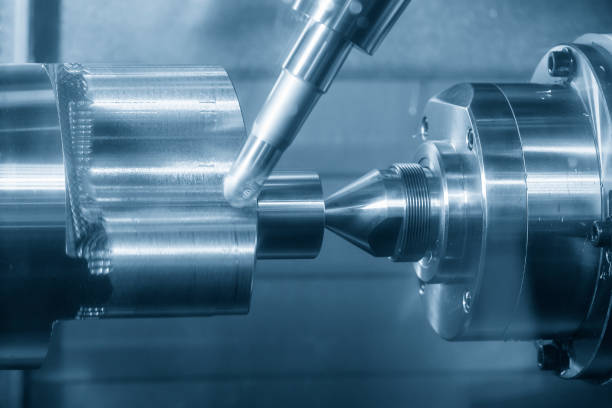
A CNC turn mill center is essentially a lathe with milling capability built in. The spindle still rotates the workpiece for turning operations, but the machine also carries live tools, rotating cutters mounted on the turret that can mill flats, drill off center holes, cut slots, and even tap threads without removing the part from the chuck. Many machines add a sub spindle, so a part can be turned, milled, then passed to a second spindle to finish the back side, all in one continuous cycle.
This is different from a standard CNC lathe, where the only motion is the tool moving in and out along the X and Y axes while the part spins. Turn mill machines add a C axis that lets the spindle stop and index to a precise angular position, plus a Y axis on many models, which opens up true three dimensional milling on a rotating part.
Why Manufacturers Choose Turn Milling
The obvious benefit is fewer setups. Every time a part gets unclamped and moved to a new machine, there is a real risk of losing datum reference and introducing runout. A part machined start to finish in one turn mill center keeps the same reference point throughout, which is a big part of why shops producing CNC turn mill parts report tighter positional tolerances between turned and milled features.
There is also a time factor that matters more than people expect. Combining operations cuts out the queue time between machines, the extra fixturing, and the handling labor. For prototype and low volume work especially, that can mean the difference between a two week lead time and a five day one.
Swiss Isle Precision, a shop known for producing cnc turn-mill parts for aerospace and medical customers, often points to complex shaft assemblies as the clearest example. A shaft with a turned diameter, a milled flat for a set screw, and a cross drilled lubrication hole used to mean three operations across two machines. On a turn mill center it becomes one program, one fixture, one inspection.
Where Turn Milling Fits Best
Turn milling shines on parts with a rotational base geometry plus off axis features, think shafts, fittings, valve bodies, and connector housings. It is not always the right call for extremely simple round parts with no secondary features, where a straightforward CNC lathe is faster and cheaper to run. And for parts that are almost entirely prismatic with little to no turning geometry, a standard three or five axis mill still wins.
Tolerances And Surface Finish
Because turn mill parts stay fixed through multiple operations, positional tolerances between features can often be held to within a few thousandths of an inch, tighter than what is realistic when transferring between separate machines. Surface finish depends heavily on spindle speed control and tool rigidity, and modern turn mill centers generally match or beat what a dedicated lathe or mill can produce on their respective feature types.
A Common Misunderstanding
Some buyers assume turn milling means the part gets milled instead of turned. In practice it is additive, not a replacement. The turning operations still happen exactly as they would on a standard lathe. Milling capability gets layered on top for the features a lathe alone cannot produce, like flats, off center holes, and slots.
Frequently Asked Questions
Q: What is the main advantage of CNC turn mill parts over parts made on separate machines?
A: Fewer setups and tighter positional accuracy between turned and milled features, since the part stays on one fixture from start to finish.
Q: Do turn mill machines cost more to run than standard lathes?
A: Machine rates are usually higher, but total part cost often comes out lower once you account for reduced handling, fixturing, and cycle time across multiple machines.
Q: What kind of parts benefit most from turn milling?
A: Shafts, valve bodies, connector housings, and fittings with both a rotational base shape and off axis features like flats, cross holes, or slots.
Q: Can turn mill machines produce fully prismatic parts?
A: They can, but a dedicated mill is usually faster and more cost effective for parts with little or no turning geometry.
Q: How does turn milling affect lead time?
A: It typically shortens lead time by removing the need to queue a part for a second machine and re fixture it, especially valuable for prototype and low volume runs.